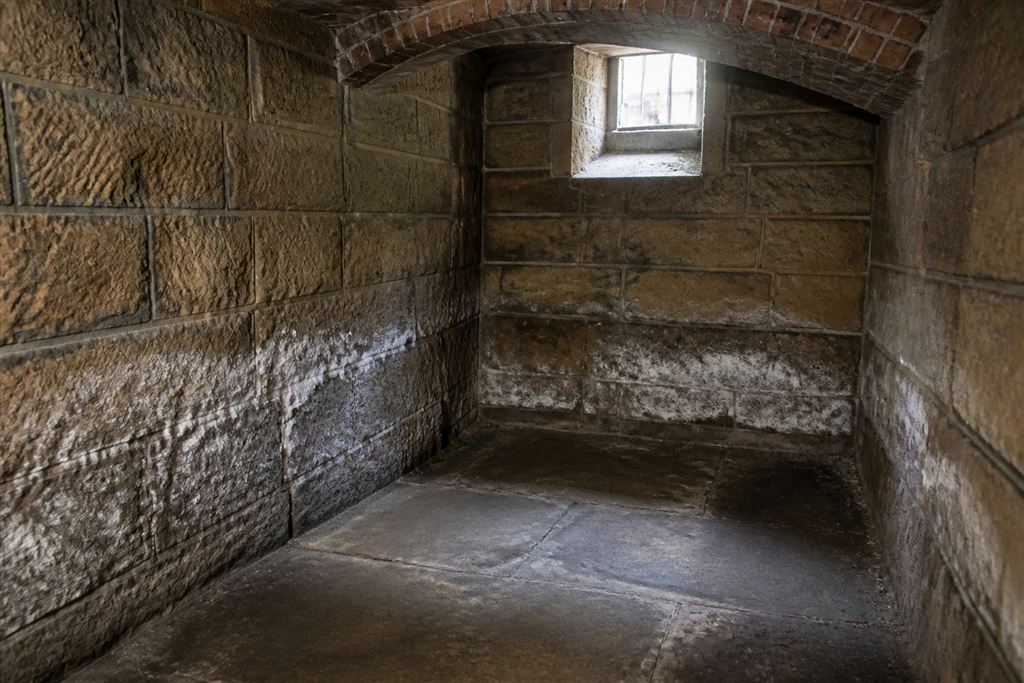
What “tanking a cellar” means on millstone grit
The phrase is used loosely. Under an Ilkley spa villa it is not:
- painting a dense cement slurry onto millstone grit and calling the stone waterproof
- buying a roll of tanking membrane and hoping the light-well drain still works on a stepped plot
- the same job as tanking a coal hole under a 1930s Leeds semi, or a one-wall room in a Worth Valley back-to-back
It is: decide how water that has already run off Rombalds Moor — through grit, lime joints, and a downhill flag floor — is going to be managed inside this chamber so the room stays usable and the elevation stays.
Three construction facts about this town drive the spec:
- The room is a storey, not a sack-hole. Victorian villas on the Wells Road climb were built with full-height cellars and often a garden light well. A sump has to sit where a later floor finish might go; that is recorded now, not guessed.
- The wall is millstone grit with lime. It was meant to breathe. A barrier coat asks porous sandstone to behave like poured concrete. Type C does not.
- The plot steps downhill. Invert on a Wells Road or Parish Ghyll slope is not a flat-garden invert. External excavation across a gritstone frontage facing the moor is the wrong first move, and Bradford’s conservation officers notice it.
Ben Rhydding (Wheatley Lane, Wheatley Grove) is still this site, but the cellar is often shallower. Middleton, north of the Wharfe, is river-level water, not moor runoff. The survey names which house it is.
What we actually specify (not a kit)
On a typical Wells Road / Queen’s Road millstone-grit cellar the sequence after survey is:
- Record the room — moisture map, invert on the slope, light-well drain, whether failed cement has lost bond, whether the building sits in the Ilkley Conservation Area or is listed, where a sump can discharge without emptying onto the downhill neighbour toward The Grove. That is the discovery survey.
- Prepare the inner face, leave the elevation. Loose cement tanking, blown slurry at the light-well reveal, and later gypsum linings come off the inside. Sound gritstone and lime stay. We do not hack the street elevation because a supplier guide showed an external dig.
- Perimeter channel at the wall/floor joint, falling to a sump. On a full-height villa that channel is long and the invert on the step matters; on a shallow Ben Rhydding store it is short.
- Cavity drain membrane on walls (and floor where flags stay wet), fixed so the dimples create a drainage gap. Water that arrives through grit after rain on the Cow and Calf side runs in the gap, not across stored wine or a future floor.
- Packaged sump and pump discharging to a legal connection on the existing drain — not a new spring on the lower terrace. Where the water goes on a sloping Ilkley garden.
- City of Bradford Metropolitan District Council Building Control where the works are structural waterproofing. Ilkley is Bradford district, not Leeds, not Harrogate, and not “included in the tin”.
That package is Type C cavity drain that leaves the stone elevation alone in homeowner English. People still call it tanking a cellar. We keep the homeowner phrase in the title and tell the truth in the body.
We mention tanking membrane and cavity drain membrane as components in a specified system. This is not a shop.
When we would not tank the whole room
A dry meter cupboard under a later house off Skipton Road is not a tanking job. A house on the later estates without a traditional cellar should say so on the form; we will not invent Type C for a floor slab. A plumbing leak from the kitchen above is a plumber, not a membrane. A one-off spill in a Ben Rhydding store that has never seen moor runoff is not a villa system.
The survey is there to kill the wrong job. Full Type C commonly sits in the £10k–£30k band; a cheap cement patch the caller hoped would be a few hundred pounds is not this service. What changes the price.
Tanking a cellar vs the phrase on the next page
Homeowners also search cellar tanking. That page is the comparison: failed cement and old bitumen already on Ilkley gritstone, versus the Type C we specify. Do not paste this page onto that URL. Why slurry tanking fails on Ilkley gritstone
Pure Basement Systems have published Ilkley case studies. YDC include Ilkley in their geography. Those are real operators with real jobs. They do not own a landing page whose H1 is tanking a cellar in Ilkley. This page is that neighbourhood service page, not a smear and not a claim on their galleries.
Conversion is not the tanking job
Ilkley villas are the conversion-heavy stock in this cluster — full headroom, light wells, spa-town buyers. Conversion is still not the H1 and not the quote from this page. If you want a habitable room later, say so on the survey so membrane laps and the sump are not ripped out when the floor finish goes down. Waterproofing still comes first. Cellar conversion in Ilkley (after waterproofing) Every button still books the survey, not a conversion quote.
FAQs
Does tanking a cellar on Wells Road mean covering the gritstone in cement?
No. Cement on millstone grit fails at the light-well reveal, at hillside settlement, and where salts crystallise behind the coat after rain on Rombalds Moor. We specify a drained cavity unless the survey finds a tiny unused space that does not justify a system.
Can you tank from the outside so the cellar stays empty of membrane?
External tanking means excavating a stepped gritstone frontage. On Wells Road, Queen’s Road and The Grove that fights the conservation elevation, the neighbour’s downhill garden, and water that is already in the stone. Internal Type C is the conservation-sensitive method this stock was built for.
Will Bradford Building Control treat “tanking a cellar” as DIY paint?
Not if it changes structure or below-ground drainage. Ilkley jobs sit with City of Bradford Metropolitan District Council Building Control, not Leeds. The discovery survey is the record for that notice.
Our house is in Ben Rhydding — is tanking the same as a Queen’s Road villa?
No. Shallower rooms, later fabric, less often in the conservation core. Still Ilkley, still this site, still a survey. Do not assume villa headroom or a light well.
How long does tanking last on millstone grit in Ilkley?
Gritstone with lime mortar keeps breathing behind a drained cavity, which is why the system lasts for decades here where a cement coat would blow at the first hillside settlement. The maintenance rhythm is a channel check after the kind of storm that sends moor runoff down the garden — that is when the system earns its keep.